
Digital Transformation.
It shouldn't
be a coin flip.
Unfortunately research puts the success rate for transformations at fewer than three in ten.
Digital transformations are harder still: only 16% of organisations say theirs both improved performance and actually stuck. This is what everyone else is offering you. Different tools every decade: mainframes, ERPs, the cloud, now AI, and it’s still the same old odds

We fix the
whole service.
Because nobody's ever
woken up excited to log into a portal.
Just ask your own staff about the last "digital initiative" and they won't mention cloud migration or system architecture. They'll tell you about re-keying the same form twice, printing a PDF to type it back into a database, or waiting ten days for an automated email that says nothing.

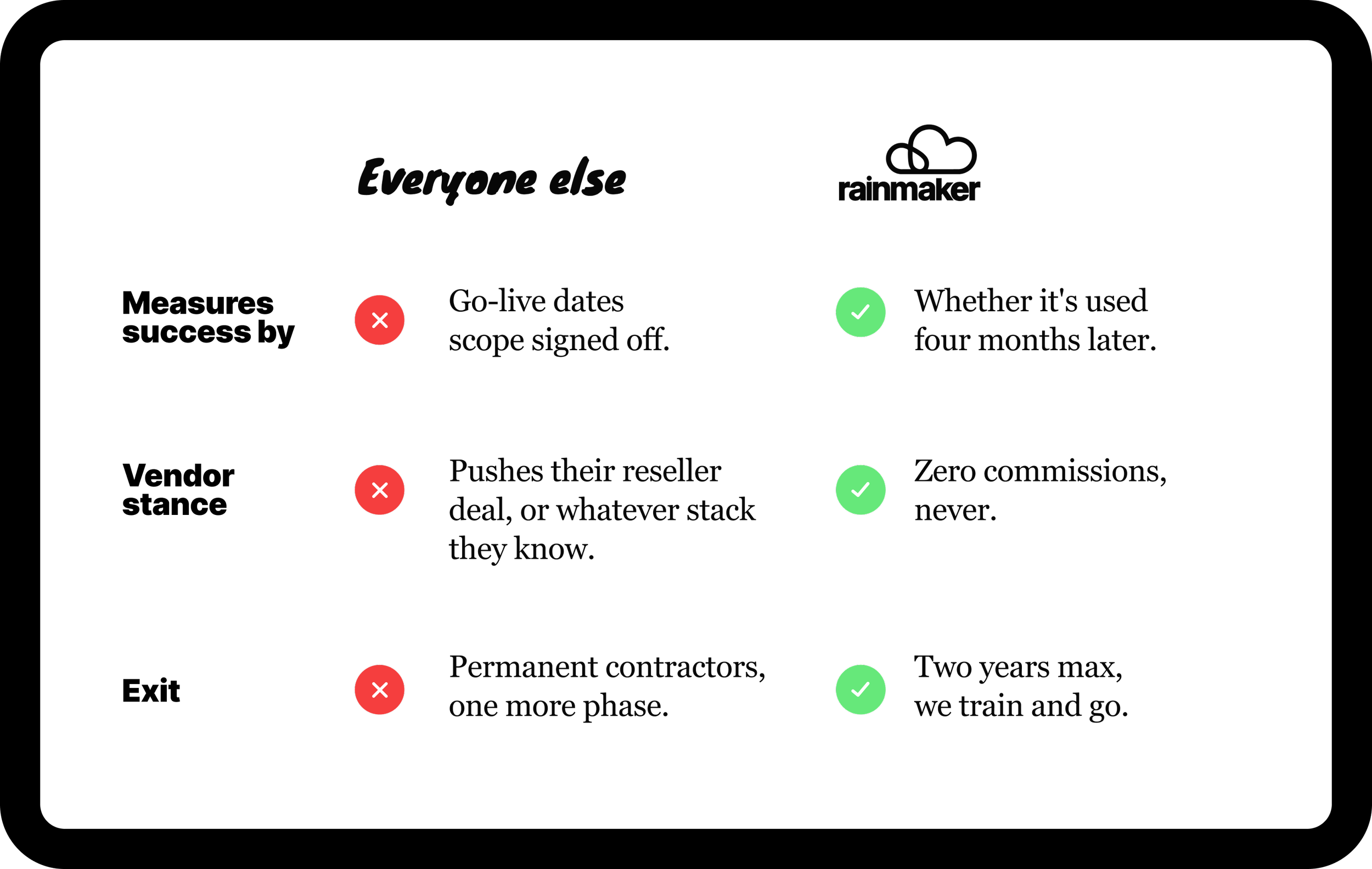
Most consultancies won't tell you this, because a three-year platform replacement pays for a lot of partner offsite. We fix the whole service instead: front end, back office, and the platform underneath, without stopping the business to do it.
Measured wrong
from day one.
A new system isn't a gain to the team using it. It's a loss, a trusted workaround, traded for someone else's promise. People weigh loss twice as heavily as gain, so "20% more efficient" lands as a loss with a better interface.
Leadership measures the go-live date because it's visible. Whether anyone's still using it four months later isn't, so that's the part that stops getting managed.
There’s everyone else,
and then us.

The bin fires
we see on repeat.
The front door looks modern. The back office is still despair.
Your portal's slick. Behind it, staff are still re-keying the same data into three different systems, because the new front end was never actually connected to anything, and nobody asked them what they'd actually need to stop doing that.
01Your IT budget is paying to keep a system alive that everyone secretly wishes would die.
Legacy contracts and licence sprawl eat the money before anyone gets to spend it on something that moves the business, or the people in it, forward.
02You want AI to do real work, but nobody trusts it with real data.
Everyone wants the automation. Nobody wants to be the one explaining the data breach, least of all the team who'll be blamed for it.
03You've bought five tools that have never once spoken to each other.
Different platforms, different eras, none of them talking. Your customers feel every one of the gaps. So does the person on the phone trying to explain why.
04If any of those sound familiar, the problem probably isn't your technology. It's the join between the technology and the people using it, and that's rarely visible from a project dashboard.
It’s not our first rodeo.
We've done this inside government departments moving millions of paper documents a year, inside a retailer competing against people with no legacy systems at all, and inside public sector IT estates burning most of their budget just staying alive. Different industries, same pattern: the technology usually works. The join between it and the people using it usually doesn't.

G-Cloud

TMF Group

Food Standard Agency
Our engagements run from 4 core services.
01
Whole
Service Mapping.
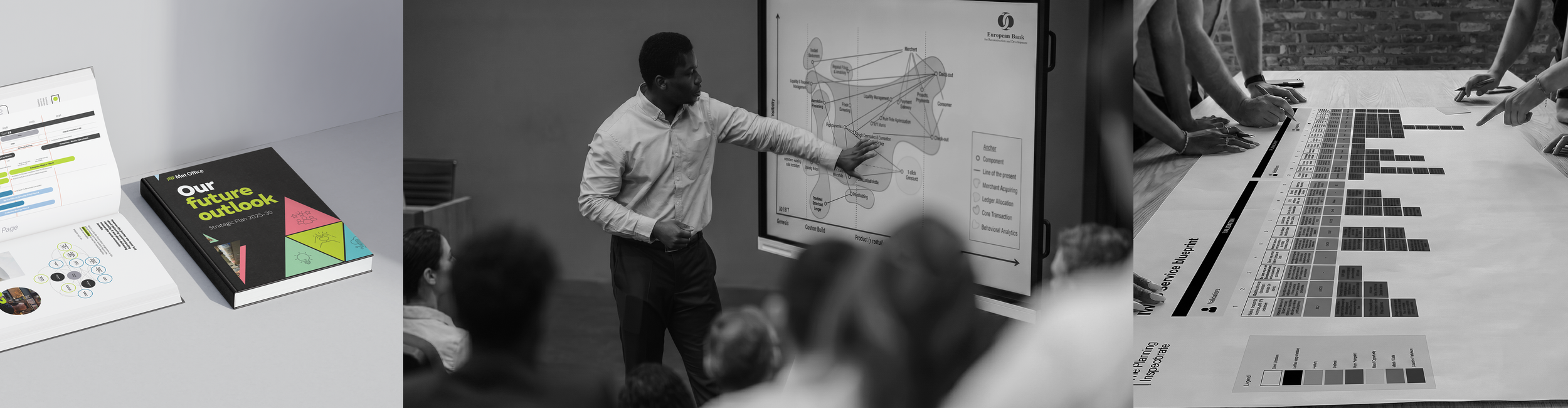
Most organisations quietly file the customer journey, the staff workflow and the technology platform in three different departments, then wonder why nobody can see the whole picture. We put all three on one page, Service, Products and Platforms, so the frontline team who feels the friction first can finally see where it's actually coming from.
02
Working
Prototypes.
Not just a roadmap slide with a robot icon on it. it could be a website, an app, an AI agent, or a bridge into a system nobody wants to touch, whatever actually closes the gap, live on your real operational data, solving one genuine bottleneck. Built behind proper access.

03
Service
Blueprinting.
Connects what the customer clicks to what actually happens backstage, the staff action, the system trigger, the legacy database query nobody wants to touch. It shows you precisely where the friction is, because we asked the person doing the job, not the person managing them.
04
Legacy
Bridging.
We build bridges into legacy systems that read and write data without forcing them offline. Your twenty-year-old core system keeps running, we just stop it being the reason everything else, and everyone touching it, is slower than it needs to be.