

EBRD
Transforming legacy IT for global impact.
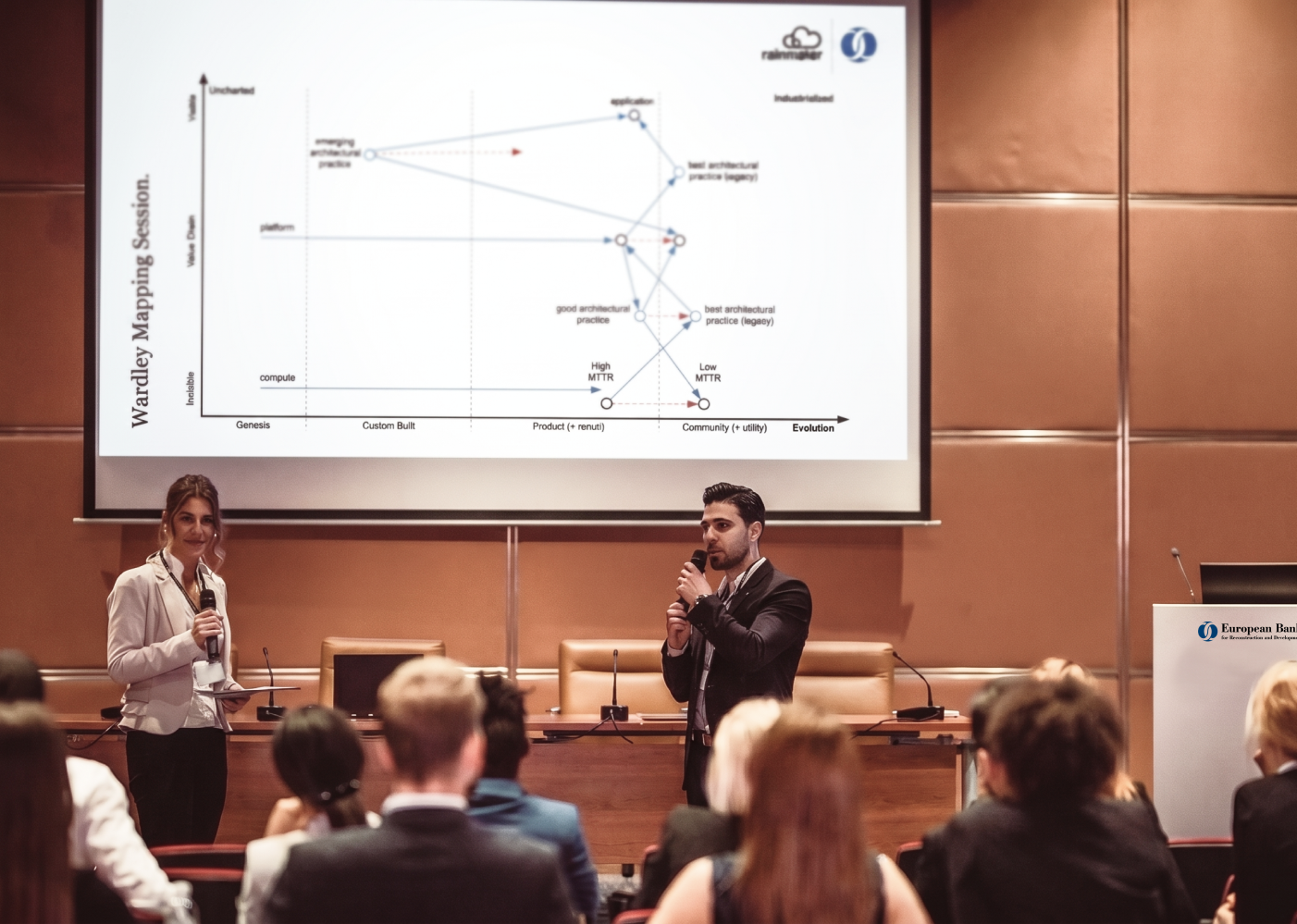
Rainmaker initially focused on understanding the bank's existing IT landscape and developing a bold vision for the future.
Realising that tactical fixes alone wouldn't unlock the necessary agility, we launched a discovery phase centred entirely on user needs. We mapped the entire IT portfolio using Wardley Value Chain Mapping, identifying opportunities to simplify workflows and consolidate systems, including within Results Management. We designed a Target State IT Operating Model and created a transformational business case that unlocked a self-funding roadmap of change to better meet the needs of the business and its users.

£18.5m
Annual savings in IT spend

42%
Potential annualised savings

57%
FTE reduction in IT ‘run’ roles, releasing capacity for transformation projects
01 The challenge we faced
As the European Bank for Reconstruction and Development (EBRD) extended its mandate and global reach, the need for a modernised, agile IT infrastructure became paramount. Historically, IT and the business operated in silos, relying on a complex variety of bespoke point solutions that struggled to scale or yield unified management insight.
The bank was facing operational bottlenecks; IT spend was heavily skewed toward "running the bank" (59%) rather than innovating and driving change. Data sources were highly decentralised, requiring users to manually input data multiple times across different stages of the investment lifecycle.
To support the organisation's future growth, the Bank needed to reduce complexity, modernise its systems, and transition to a more agile, user-focused delivery model.

02 Tacking the problem
Rainmaker’s initial focus was running a short discovery phase including extensive stakeholder interviews to understand the true staff experience and current architecture.
Though £4m p.a. in tactical savings were quickly identified through project consolidation and supplier management, our analysis found that resolving point-issues alone would not deliver maximum benefit; the end-to-end IT delivery model needed to evolve.
We blueprinted the entire IT landscape using Wardley Maps, evaluating the portfolio and highlighting opportunities to transition from bespoke platforms to easy-to-maintain commodity solutions. We also designed a Target State IT Operating Model that introduced a centralised Change Delivery function to govern all IT and business change, ensuring total organisational alignment.
To demonstrate this new methodology, we selected "Results Management" as an exemplar project. We avoided the historic pitfalls of technology-led solutions by focusing strictly on user needs, developing a business case to unify reporting, capture data once for reuse, and link the bank’s mandate directly to its operations.
As a result, a comprehensive, self-funding transformation roadmap was ratified by Excomm, underpinned by guiding principles to "Be bold and do less," shifting the bank from a highly complex state to an aligned, automated, and simplified future.
03 Key skills we used
Strategic Discovery & User-Centric Design
Value Chain Mapping & Strategic Gameplay
Operating Model & Organisational Design
Financial Modeling & Business Case Development
Enterprise Architecture & Smart Sourcing
Change Management & Portfolio Optimization
“To challenge ourselves and the business to be exemplary in leading and delivering aligned, efficient and innovative services that enable the Bank to drive its vision.”
VP Vision
European Bank for Reconstruction and Development (EBRD)

Ready to get started?